This site uses cookies for better user experience and analytics.
The science
Your body reads the time from the sky.
Time of day--:-- ·
0:006:0012:0018:0024:00
Drag the time and watch the light change.
Light at this hourSkyOrdinary bulbwakes you up
420580780 nm
Daytime signal (daylight = 1)Sky–Ordinary bulb–
Drag the sun. Blue overhead means day; no blue means night. Your bulb should say the same.
A clock in the eye
Your eyes have a sensor that only reads the time.
It sits apart from the cells you see with and responds to the blue-cyan part of the light. The more of that light, the more “day” your body hears.
Noon daylight1.00
Ordinary LED, 2700 K0.44
Campfire0.20
vitae, night mode0.015
Daytime signal = melanopic daylight efficacy ratio (MDER, CIE S 026): how strongly a light talks to the body clock, with daylight = 1.
A day under your lights
The light that reaches your eyes sets the time your body keeps.
Your body reads the time from the light at your eyes: plenty by day, little in the evening, none at night. Run a day in this home and see where the light comes from, at the table, on the sofa and in bed, and what to change.
Where
In the evening
Bulbs in your lamps
–lx of daytime signal at the eyes
Daytime signal at your eyes, hour by hour
Your body reads more than brightness: it reads how much day is in the light, the blue-green part of daylight (scientists call the share MDER). Daylight is 1, a warm white LED 0.44, vitae at night 0.015. Signal = lux × MDER. The green shows how much your body wants: lots by day, little in the evening, none at night. The line should stay in the green.
Daytime signal = melanopic EDI at the eyes (CIE S 026): lux × MDER, the melanopic daylight efficacy ratio of the light, on the plane the face looks at. Recommendations: Brown et al., PLOS Biology 2022. The model: an equinox day in Prague under a clear sky; the window faces away from the sun; lamps are points with their shades: a Tolomeo Mini on the table, a Melampo behind the sofa and a Tolomeo Pinza clipped to the bed, none shining into the eyes. Ordinary LED: 2700 K (MDER 0.44, 470–1055 lm) in every lamp, plus a ceiling light. vitae: Home Office in the Tolomeo Mini (4000 K for work, 2700 K at dinner), Bedroom 2.0 in the Melampo and the Pinza (2000 K, 1600 K for reading from 20:00, orange 1200 K for the last quarter hour). Asleep at 23:00 under ordinary LEDs and at 22:00 with vitae, because melatonin rises sooner in dim orange light (room light before bed delayed it and cut it short by about 90 minutes in Gooley et al. 2011). The ceiling light is only in the ordinary-LED home: vitae is made for lamps near you, not ceiling lights. A sketch that shows the size of things, not a measurement of your home.
Screens after dark
If the screen has to stay, make it red.
A phone 30 cm from the eyes gives more daytime signal than every lamp in the room. A red screen leaves out the blue and green the body reads as day. Set it up once, then switch it with three clicks.
iPhone and iPad
Settings → Accessibility → Display & Text Size → Color Filters: switch it on and choose Color Tint.
Move Intensity and Hue all the way to the right: the screen turns red.
Settings → Accessibility → Accessibility Shortcut (at the very bottom): pick Color Filters.
Now three clicks on the side button (the Home button on older models) switch the red screen on and off.
Android
Samsung: Settings → Accessibility → Visibility enhancements → Colour filter: choose red and turn the intensity up.
Pixel and other phones: look in Settings → Accessibility for a colour filter or colour correction. The names differ from phone to phone.
Add it to the accessibility shortcut (button or volume keys) to switch it fast.
No red option? A red-filter app such as Twilight does the same.
Computer
f.lux (free, for Mac, Windows and Linux): in its menu, turn on Darkroom for red on black.
Mac without an app: System Settings → Accessibility → Display → Color filters → Color tint, set to red. Add it to the Accessibility Shortcut (Option-Command-F5).
Windows Night light helps but never goes fully red, so f.lux is the better choice.
Turn the brightness down as well: less light is less signal.
Menu names change a little with each system version.
Try it
One bulb. Three modes. Just flip the switch.
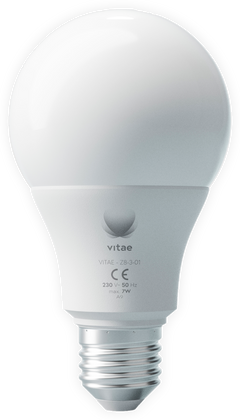
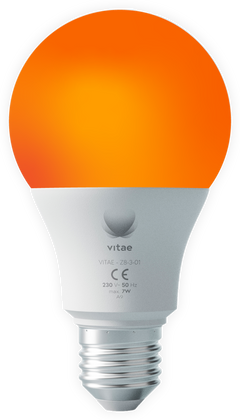
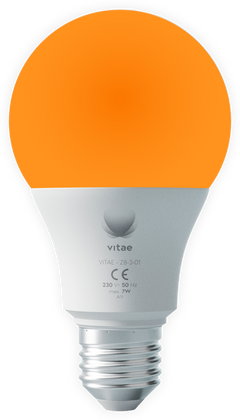
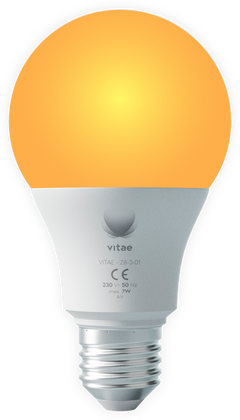
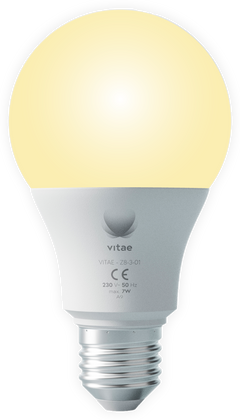
Flip the cord switch: a vitae bulb always wakes on its warmest, blue-free setting. Add a classic bulb, the sun or a fire from the shelf and compare. Watch the left of each spectrum, the band that tells your body it's daytime.
Cord switch · vitae only
11s
From 1.990,00 Kčor rent with Bulbsharing® from 65,00 Kč/mo
vitae from the datasheet; classic bulbs and nature are typical values. Bar height follows brightness. Day signal = MDER (noon sun 1.0, candle 0.2).
What changes
Take away the blue at night and sleep follows.
Most people feel it within a few nights: falling asleep comes easier, mornings come lighter.
“To deliver the best, we test what we make, keep up with the science, and occasionally lose a little sleep so you don’t have to.” Hynek Medřický, inventor of vitae